Haven 4.4 Review: “Lost and Found”
By John Keegan
 Like the majority of episodes this season, “Lost and Found” balances the long-term plot arc of Audrey/Lexie, her fate, and the impact on the whole situation in Haven with the “Trouble of the Week” format. The latter keeps things grounded in familiar territory while the big changes to the 27-year cycle are explored in the former, but it also takes something away from the notion that things are dramatically different than they have been in the past few centuries.
Like the majority of episodes this season, “Lost and Found” balances the long-term plot arc of Audrey/Lexie, her fate, and the impact on the whole situation in Haven with the “Trouble of the Week” format. The latter keeps things grounded in familiar territory while the big changes to the 27-year cycle are explored in the former, but it also takes something away from the notion that things are dramatically different than they have been in the past few centuries. The “Trouble of the Week” was unusual, to say the least. A couple with a yearning to conceive ends up generating a Trouble that manifests itself as a Caribbean demon child that lures real children to their doom. The idea of children being compelled to play to death is a chilling one; it certainly feeds on the societal fear of malignant forces hiding within our communities to steal and kill children.
Unfortunately, much of what happened with Lexie was fairly predictable, and just needed a little time to develop. That time was spent on the A-plot, and there didn’t seem to be enough plot to make that case fill the time that it needed to fill. When the story seems to reach a natural conclusion about halfway through the episode, that’s not a good sign. I was left waiting for the obvious to take place, or the events with Lexie and Nathan to start dominating the proceedings.
As I said, much of that was predictable; I don’t think anyone was stunned by the revelation that Lexie didn’t somehow revert to Audrey. There was simply too much riding on the simplicity of Audrey coming back, killing Nathan, and restoring the cycle to the way it was supposed to be. Instead, we have something far more interesting. Audrey may not even exist anymore, Lexie is the conduit to the power/agency behind the barn, and no one has a connection to Lexie, other than perhaps Jennifer. Oh, and thanks to the third season finale, restoring the cycle is no longer an option. Resolving the Troubles once and for all seems to be the only path forward.
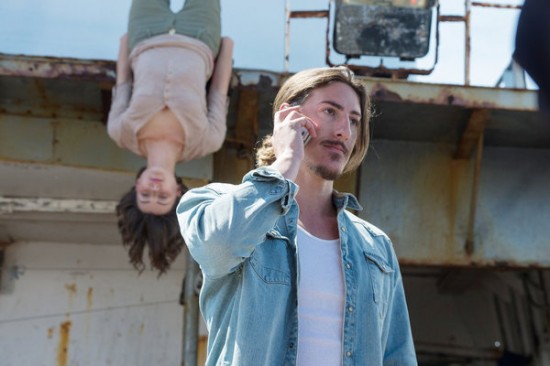 To that end, a big hint was dropped in this episode, though it’s not exactly a new idea. William (more and more likely to be the new avatar of “the barn”) mentions that the barn itself is a representation of the intersection between two worlds. The implication seems to be that the Troubles are a result of the doorway to this “other world” being opened. Since the Troubles are genetic, it follows that the original families of Haven were altered by exposure to the energies or nature of this “other world”.
If that is the case, then things start to fit together a bit more. “Audrey” has been said to come when the source of the Troubles gets so powerful that she needs to come and “absorb” it, via whatever mechanism, and then enter the barn (the space between worlds) to remove it from the system. Thus the energies that fuel the Troubles are removed, and the latent genetic issues return to their dormant state.
Duke’s experience in the barn (being expelled from it) suggests that “Audrey” is something unusual. One possibility is that she was an original resident of Haven when whatever incident went down, and she was altered to the extent that she became the conduit she currently represents. The other possibility, and the one that facilitates a conclusion much more clearly, is if “Audrey” is actually a being from the “other world”. When the energies of the “other world” increase enough to spark the Troubles, “Audrey” is drawn out of the “space between” back into Haven, with memories and personality imprinted by some “to be revealed” circumstance. This could explain why she is uniquely immune to the Troubles. It also implies, to some degree, that “Audrey” may in fact be an indirect cause of the Troubles. She may need to return to the “other world”, and seal the breach that clearly remains open, to solve the problem once and for all.
Assuming any of that is correct, the writers are well on their way to the endgame, which is actually quite intelligent on their part; Syfy, after all, has never sustained a non-“reality” scripted series more than five seasons. The trick now will be taking Jennifer, who is increasingly endearing and fun as a character, and giving her a distinct path forward. As a mechanism for understanding the truth about “Audrey” and her fate, she served a purpose. Hopefully her connection to “the barn” and what it represents will continue to be meaningful.
John Keegan is Editor-in-Chief for Critical Myth, a partner site of SciFi Vision.

Latest Articles
Interviews
 Spider-Noir: Hnedel Maximore Breaks Down the Emmy-Nominated Visual Effects
 Wednesday, 05 August 2026
 Foundation: Chris MacLean on Building the Show's Epic VFX, The Emotional Season Finale & More
 Tuesday, 04 August 2026

 Summer's Last Resort: Jerry O'Connell, Sophia Bush & Violet McGraw on Comedy, Chaos & Water Park Fun
 Friday, 03 July 2026

 FROM Stars Nathan D. Simmons and Kaelen Ohm on Their Characters' Emotional Exits
 Tuesday, 30 June 2026
 Spider-Noir: Lukas Haas on Costume, Old-School Noir Inspiration, and Working with Nicholas Cage
 Monday, 29 June 2026
 FROM Star Pegah Ghafoori on Fatima's Transformation, Fan Theories & What's Next
 Monday, 29 June 2026
 Ron Perlman on Playing Dead, Facing Noah Pierson, and More in The Capture Season 3
 Tuesday, 23 June 2026

Reviews


